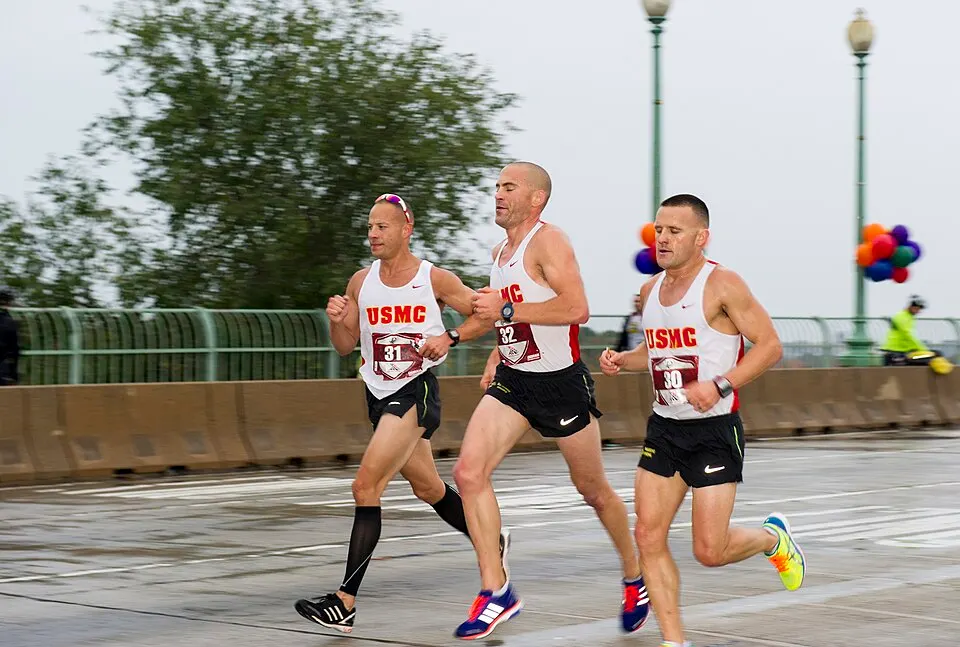
Arlington, Virginia, and Washington, D.C., USA · Rookie
Marine Corps Marathon: can you walk much of it and still finish?
The October marathon is said to be the world’s largest race without prize money. Time limit looks forgiving, but three clocks above course test the first full marathon runners before anything else.
Can the course be finished at almost a walking pace? That is the first question for anyone choosing a first full marathon.
The Marine Corps Marathon has one answer: 14 minutes per mile. Converted to kilometers, that is 8 minutes 42 seconds.
It is a pace within reach when brisk walking is mixed with an easy run. But the thing that stops runners here is not the average pace.
It is the clocks near 17 miles, at 20 miles, and in Crystal City. Three wall clocks hang above course, and runners who miss those times are sent off the course.
No official finish is recorded. The 51st race takes place on October 25, 2026.
The U.S.
Marine Corps operates it, and the official website calls it the third-largest marathon in the United States. Is it a good first marathon?
Yes—provided two things are managed: when start line is crossed and how the first 2 miles are run.
1The Finish Standard Is 14 Minutes for 1 Mile, With Run-Walk Allowed
The official FAQ is brief. The marathon requirement pace is 14 minutes per mile, and runners must pass cut-off point. Covering all 26.2 miles at that pace takes 6 hours 6 minutes 48 seconds.
It is the equivalent of running 42.195km at 8 minutes 42 seconds per kilometer. For a first-timer, that is a generous number. Running 1km at 6 minutes 30 seconds and walking for about 2 minutes still produces an average in the 8-minute range.
Even stopping at aid station to empty a cup before setting out again does not throw the calculation far off. So if the concern is “not being able to run all the way,” the focus can shift. The course does not require legs that never stop.
It requires the habit of stopping and starting again—and the ability to read the clock.
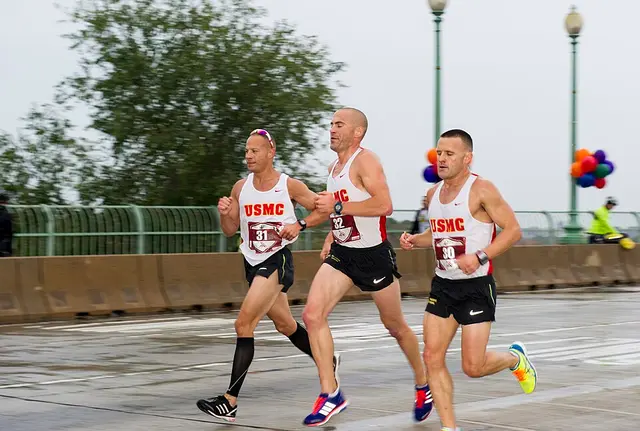 Marine Corps MarathonOctober 2027 · expected · Arlington, United StatesSee race details
2Three Checkpoints, With the Start Line Crossed by 8:35 a.m. at the Latest
There are three cut-off point times: DC Gate at 12:33 p.m.; the 14th Street bridge before 20 miles, at the intersection of 14th Street and D Street, at 1:15 p.
m.; and Crystal City Gate at 1:49 p.m.
All three are wall-clock times, not chip times. Runners start at 7:20 a.m.
Wheelchair racers start first at 7:05, followed by the duo division at 7:07. Now run the numbers. At a 14-minute pace, 20 miles (32.2km) takes 4 hours 40 minutes.
Subtract 4 hours 40 minutes from 1:15 p.m. and the result is 8:35 a.
m. The 17-mile point (27.4km) takes 3 hours 58 minutes; subtract that from 12:33 p.m.
and the result is again 8:35 a.m. The cut-off point clock matches the schedule for a runner who crosses start line at 8:35 and runs at a 14-minute pace.
Put another way: a runner who crosses start line at 7:30 and holds the 14-minute pace reaches the bridge at 12:10 p.m., with 65 minutes to spare.
Crossing at 8 reduces that margin to 35 minutes. The later the starting mat is crossed, the more rest time disappears from course.
3The First 2 Miles: The Rosslyn Climb
Start line sits on Route 110 between the Pentagon and Arlington National Cemetery. Gear check is at the Runners Village in the North Pentagon parking lot. When the gun goes off, course heads straight toward Rosslyn.
The first 3.2km climb. People often say beginners fall apart after 30km. In this race, the damage is done within the first 3km.
Caught up in the mass start, many runners attack the climb at their flat-road pace, pushing their heart rate to late-race levels before the race has properly begun. Then comes a long descent along Spout Run, where the legs pick up speed. By the time the course crosses the Potomac River and reaches Georgetown’s cobblestones, even the ankles are tired.
One rule is enough here: maintain a pace at which conversation with the runner beside you remains possible until the 2-mile marker. Even if that pace is slower than 14 minutes, it is fine. The time bank calculated earlier is there to be spent on climbs like this.
4The National Mall Section and the 12:33 p.m. DC Checkpoint
After crossing the Potomac River again, course enters the heart of Washington. The Lincoln Memorial, Washington Monument, U.S.
Capitol, Tidal Basin and Jefferson Memorial all lie along the course. For a first-time runner, a scene worth photographing appears every few km. At 12 miles, about 19.3km mark Hains Point, runners pass the “Wear Blue: Run to Remember Mile.”
The 1-mile stretch honors service members who died in the line of duty. It is the clearest reminder that the race is organized by the Marine Corps. The DC gate near mile 17 closes at 12:33 p.
m. Time passes quickly on the most scenic sections. Stopping for a photo is fine.
Check the watch first. The 5 minutes spent at 12 miles come straight back at the gate near mile 17.
514th Street Bridge Cut-Off at 1:15 p.m., Cup-Free Aid Stations
Another name for this race is “Beat the Bridge.” The intersection just before the climb onto 14th Street Bridge at mile 20 closes at 1:15 p.m.
Runners who arrive late are diverted outside the official course. Even if they cross the finish, they are not official finishers. There is one aid station the bridge, with runners serving themselves rather than taking a cup.
The course has 12 aid stations, and Nuun sports drink is available as well. There are 10 medical aid stations. For first-time runners, carrying a collapsible cup or small bottle makes the aid station the bridge easier.
After the bridge, 6.2 miles, about 10km, remain. The Crystal City gate closes for the final time at 1:49 p.m.
Arriving at the bridge at 1:15 means covering the remaining distance in 34 minutes. That is why a plan to clear the 20-mile cut-off point by the narrowest margin is risky. The schedule should allow arrival at the bridge at least 20 minutes early.
6Finish at the climb’s end, in front of the Iwo Jima Memorial
After passing through Crystal City and returning to Arlington, runners see finish. It stands in front of the Marine Corps War Memorial, commonly known as the Iwo Jima Memorial. The last 320m or so is uphill.
The slope is short but unmistakable after 42km of running. Finishers receive a banana, bottled water, Nuun tablets, vegetable sticks and a fruit cup. The Finish Festival runs in downtown Rosslyn from 8 a.
m. to 4 p.m.
The trip home is the final cut-off point of the race. After last year’s event, an escalator at Rosslyn Metro station was out of service, waits stretched to nearly 45 minutes, and some trains passed without stopping. From about 10 a.
m. to about 5 p.m.
, shuttle buses run from Oak Street and Wilson Boulevard in the finish area to 23rd Street and Crystal Drive in Crystal City. After nearly 6 hours of running, checking the shuttle line before joining the queue for the station stairs is easier on the body.
7$240 Entry Fee, With Reserved Bib Pickup at the Museum
Entry fee costs 240 dollars for the general public and 225 dollars for active-duty military personnel. The official page says registration for 2026 is open. One point matters before registering: the 2026 race does not allow bib transfers or deferrals to the following year.
Full marathon is open only to runners aged 14 and older. Bib is picked up at the National Building Museum (401 F Street NW) in Washington, D.C.
, from October 21 through 24, daily from 10 a.m. to 6 p.
m. A time slot must be selected and reserved in advance; pickup is not available on race morning. Take the Metro to start line.
For the previous race, Pentagon and Pentagon City stations on the Blue and Yellow lines began operating at around 5 a.m., while extensive road closures around Key Bridge and Wilson Boulevard made driving difficult.
The 8:35 a.m. calculation from earlier takes on a different meaning in light of those early trains.
Every minute gained by arriving early becomes time available at course.
Editor's pick
For a first full marathon, the Marine Corps Marathon is a reasonable choice. Two conditions apply. First, 42.195km must be covered at an average pace under 10 minutes per kilometer.
Walking is fine. The 14-minute pace calls for 8 minutes 42 seconds, but the actual time available may be more generous or tighter depending on when start line is crossed. Second, start line must be reached before 8 a.
m. Crossing at 8 leaves 35 minutes before the bridge, even at a 14-minute pace. Those 35 minutes cover the first 2 miles of climbing, photos on the National Mall, and aid station the bridge.
There are runners for whom this race is a poor fit: anyone planning on 6 hours 30 minutes or more, or anyone expecting to walk more than half the course. The cut-off point times are tied to the 14-minute average pace, so a plan that slows sharply in the second half ends before 20 miles. In that case, a race with a looser cut-off point is the safer first choice than time limit.
Once the decision is made, the first task is to reserve a Packet Pickup time slot for October 21–24. Next comes checking the Metro schedule before dawn on race day.
More important than the 7:20 a.m.
starting gun is the time the starting mat is crossed.
Entry period · Accommodation
| Races | Itinerary | Entry period | INFO. |
|---|---|---|---|
| Marine Corps Marathon | October 2027 · expected | Not yet open | Accommodation · See race details |
Auto-translate on · Official race site
More stories
 December Marathons in Southeast Asia: Singapore Costs the Most, Chiang Mai Has No Lottery
 The 6 Majors and Sydney: Some Courses Are Built for PRs, Others for the View
 New York City Marathon: Five More Ways In Besides the Drawing
 Platinum Label Isn't Just for the Majors: Valencia, Seoul, Lisbon, and More