New York, United States · Rookie
New York City Marathon: Five More Ways In Besides the Lottery
The 2025 race drew more than 200,000 applicants and 59,226 finishers. There's no stated time limit, but there is a 10 p.m. cutoff, and the general drawing for 2026 already closed on February 25. The entry fee is $315.
What happens if you don't finish within 7 hours? It's the first worry for anyone signing up for a first marathon, and in New York on November 1, 2026, the answer is a little different.
The TCS New York City Marathon has no time limit measured in hours. Instead, there's a clock time: 10 p.
m. Keep a pace of 16 minutes per mile or faster and the course stays open, and official finish times count until then, no matter when you started.
Finish after that and you'll still get a medal, but not an official time. The entry fee is $315.
At this race, though, the time limit is one of the easiest hurdles. The hard part is getting to the start line.
1A Bridge Start, 11 Miles Through Brooklyn
The start is at Fort Wadsworth on Staten Island. Runners head up onto the Verrazzano-Narrows Bridge, closed to traffic for the day, using both the upper and lower decks at once. That means the first mile is uphill.
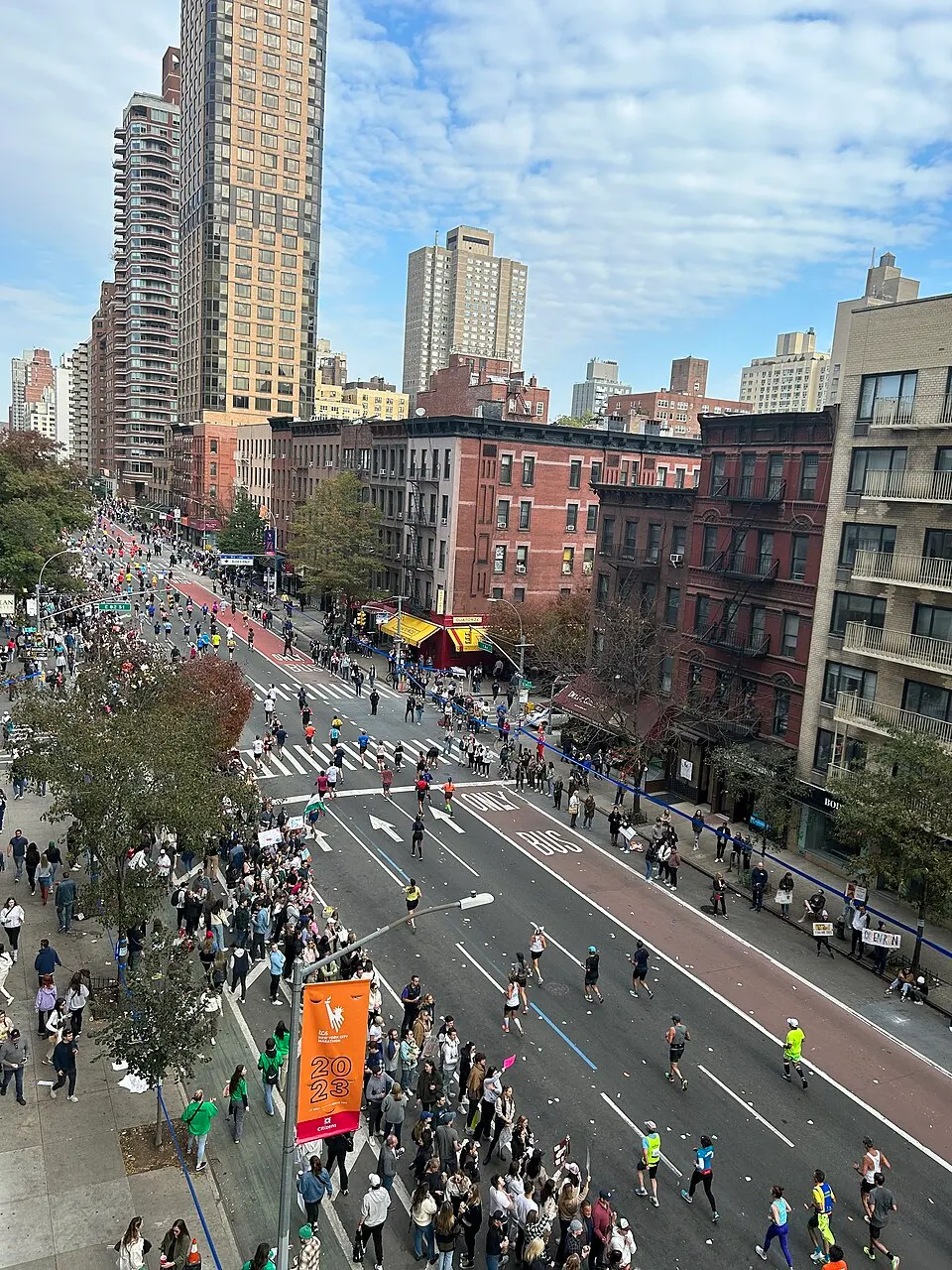
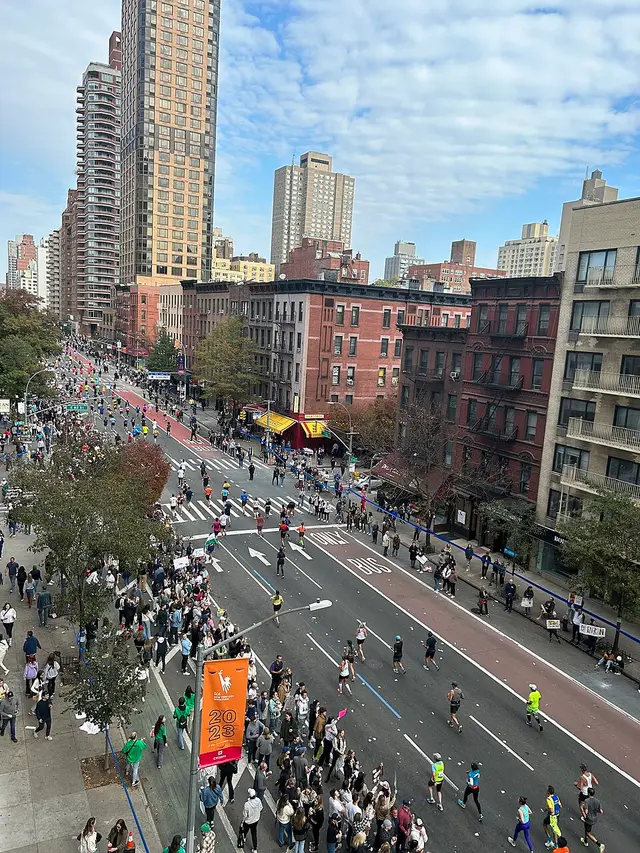
Off the bridge, Brooklyn runs for about 11 miles. The course follows Fourth Avenue and Bedford Avenue through Bay Ridge, Sunset Park, Park Slope, Bedford-Stuyvesant, Williamsburg, and Greenpoint. It's the flattest and loudest stretch of the course.
This is where first-timers often go wrong. Add the time banked on the bridge descent to the noise of the crowds, and you end up running faster than planned. Until you cross the Pulaski Bridge at halfway into Long Island City, Queens, treat those 11 Brooklyn miles as an exercise in restraint.
 New York City MarathonSun, November 7, 2027 · D-357 · New York City, United StatesSee race details
2From the Queensboro Bridge Climb to the Central Park Finish
Around mile 15.5, the course crosses the East River again, on the lower level of the Queensboro Bridge—widely considered the toughest point on the route. That's roughly 25K in. Spectators aren't allowed on the bridge, so the noise suddenly drops away.
Off the bridge, First Avenue runs straight north. The course dips briefly into the Bronx over the Willis Avenue Bridge, then returns to Manhattan via the Madison Avenue Bridge. The rest of the way runs through Harlem and down Fifth Avenue.
The course enters Central Park at East 90th Street, and the final mile runs along Central Park South before finishing next to Tavern on the Green. On Fifth Avenue, a gradual climb continues all the way to the 90th Street entrance. From Staten Island through Brooklyn, Queens, the Bronx, and Manhattan, it covers 42.195 kilometers (26.2 miles) across all five boroughs.
3Beyond the Drawing: 9+1, Charity, Qualifying Times, and Tour Operators
Entry is mainly by drawing. More than 200,000 people applied for the 2025 race, and the general drawing for 2026 opened on February 4 and closed on February 25. The $315 entry fee applies no matter which route you take.
There are five other ways in besides the drawing. The 9+1 program means finishing nine NYRR-organized races and volunteering once in the same year. NYRR charity memberships offer spots at the 5K or 10K level.
Finishing this race 15 or more times qualifies you on its own. You can also meet an official qualifying time or run with a registered charity team. The sixth is an official tour-operator package.
Hotel and flights are bundled in, which drives up the price, but an entry comes with it fairly reliably. For first-timers, the realistic options are usually a charity team or a tour package. The 9+1 route means living in New York and giving it a year, and 15 finishes simply takes time.
4A 2:53 Qualifying Time Guarantees Entry Only at Designated Races
Qualifying times are based on net time, and only times run between January 1 and December 31, 2026, count. In the published table, the standard for men 18–34 is 2:53:00; for women and nonbinary runners in the same age group, it's 3:13:00. Other age groups have their own age-graded standards.
Here's where many runners get it wrong. Beating the standard doesn't get you in automatically. Your entry is confirmed only if you ran the time at an NYRR-designated race.
A time from any other race just makes you eligible to apply for a limited number of spots, and if too many apply, the fastest times get in. In short, a qualifying time isn't a key that lets you skip the drawing. It only works if the race where you ran it counts, too.
If you can already run 2:53, your next step is to pick an NYRR-designated race for next season. Standards as of August 12, 2026.
5No Time Limit, but a 16-Minute-Mile Pace and a 10 p.m. Cutoff
There's no stated time limit. As long as you keep a pace of 16 minutes per mile or faster, the course stays open. A 16-minute mile works out to about 7 hours over the full 42.195 kilometers (26.2 miles), but that's a course-opening standard applied section by section, not an announced overall time limit.
What matters is the clock. Official finish times count until 10 p.m.
ET, no matter when you started. Cross the finish line after that and you'll still get a medal, but not an official time. That setup ties into wave assignments.
Wave 1 starts at 9:10 a.m.; Wave 5 starts at 11:30 a.
m. With the same 10 p.m.
cutoff, Wave 1 gets 12 hours, 50 minutes, while Wave 5 gets 10 hours, 30 minutes. A later wave means that much less time. Still, there's plenty of margin.
The 2025 race had 59,226 finishers. If your goal is simply to finish, the time limit is no reason to rule out this race.
6Wave-by-Wave Corral Closures and the Staten Island Ferry
Before you look at your start time, check when your corral closes. Wave 1's corral opens at 8:10 a.m.
and closes at 8:45 a.m. Wave 2 runs from 9:05 to 9:25, Wave 3 from 9:45 to 10, Wave 4 from 10:25 to 10:40, and Wave 5 from 11 to 11:15 a.
m. Miss the cutoff and you can't start in your assigned wave. The start village is at Fort Wadsworth.
There are three official ways to get there from Manhattan, and your assigned wave determines which one you use: a dedicated bus from Midtown, the Staten Island Ferry plus a shuttle bus, or a ferry from Midtown. If you're taking the Staten Island Ferry, head to the Whitehall Ferry Terminal. It's reachable from South Ferry on the 1 train, Whitehall Street on the N, Q, and R, and Bowling Green on the 4.
The ferry is free, and so is the shuttle bus from the St. George Terminal to Fort Wadsworth. It's also worth knowing the road closures in advance.
The Bay Street and Lily Pond Avenue exits on Staten Island close at 3 a.m. and don't reopen until around 4 p.
m. Work backward from your corral closing time, subtracting the ferry and shuttle, and it's clear you'll be waiting a long time before the start. A throwaway layer isn't extra baggage—it's part of your race-day kit.
7Bib Pickup Is Limited to 3 Days at the Javits Center, With No Race-Day Pickup
You can't pick up your bib on race day. There's no way to get it on the morning of November 1, so build your schedule around that first. Pickup is at the Jacob K.
Javits Convention Center, on 11th Avenue between West 35th and 36th streets. Hours are 10 a.m.
to 8 p.m. on Thursday, October 29; 10 a.
m. to 8 p.m.
on Friday, October 30; and 9 a.m. to 5 p.
m. on Saturday, October 31. Bib pickup ends 30 minutes before closing each day: 7:30 p.
m., 7:30 p.m.
, and 4:30 p.m. You have to go in person with a photo ID and your runner confirmation; no one can pick up on your behalf.
You choose a pickup time slot in advance on your NYRR dashboard and can change it until 4 p.m. ET on October 31.
In practice, that means being in Manhattan by the afternoon of October 31 at the latest.
8After the Finish: Getting Out of Central Park
The finish line is next to Tavern on the Green in Central Park. To get to the subway, you'll be heading out near West 67th Street and Central Park West. On race day, most routes across the park are closed.
The 65th, 79th, and 96th Street transverses shut down, and buses can't cross Fifth Avenue. Crowd control is in place at stations near the finish. Train service is different that day, too.
The northbound 1 runs express between 96th Street and 145th Street, and the northbound 6 runs express from Grand Central to 125th Street. If you don't check your stop in advance, you'll ride right past it. If friends or family are coming to cheer, Queensboro Plaza (7, N) and Lexington Avenue–59th Street (4, 5, 6, N, R) are close to the course.
Spectators line nearly the entire route through all five boroughs. On the first Sunday in November, New York gives the whole day over to the race. It's also a World Athletics Platinum Label race on an AIMS-certified course.
Editor's pick
If you're running New York for the first time, here's the order of things. Don't start by worrying about the time limit. A 16-minute-mile pace and a 10 p.
m. cutoff leave plenty of room for a first marathon. What you should worry about is how to get to the start line.
The 2026 general drawing opened on February 4 and closed on February 25. That door is shut for this year. The two routes left are a registered charity team and an official tour-operator package.
Tour packages bundle hotel and flights, which pushes up the price but makes entry relatively certain; charity teams come with a fundraising requirement. Either way, you'll pay costs on top of the $315 entry fee. If you want to qualify with a time, the math is different.
For ages 18–34, the standard is 2:53:00 for men and 3:13:00 for women and nonbinary runners. Run that time at an NYRR-designated race and your entry is confirmed; a time from any other race only makes you eligible to apply for a limited number of spots. In other words, which race you run next season is already part of your New York entry.
Once you're assigned a wave, lock in your travel dates. Wave 5 starts at 11:30 a.m.
, and bib pickup ends at 4:30 p.m. on October 31.
Those two times set your arrival and departure dates.
There's one thing to do next: read the requirements for 9+1 and charity teams before the 2027 drawing opens. The 2026 window ran from February 4 through February 25, so expect the next one around the same time.
In New York, the race starts with registration, not on the course.
Entry period · Accommodation
| Races | Itinerary | Entry period | INFO. |
|---|---|---|---|
| New York City Marathon | Sun, November 7, 2027 | Not yet open | Accommodation · See race details |
Auto-translate on · Official race site
More stories
 December Marathons in Southeast Asia: Singapore Costs the Most, Chiang Mai Has No Lottery
 The 6 Majors and Sydney: Some Courses Are Built for PRs, Others for the View
 Platinum Label Isn't Just for the Majors: Valencia, Seoul, Lisbon, and More
 If You Run Just One Marathon Abroad, Make It Vienna—Not Osaka or Paris