Discover · Rev
Worried about marathon cutoffs? Osaka if you cross the start late, Kobe if you fade late
An elevation profile shows the shape of the course; a cut-off point schedule shows the pace the organizers require. From Boston to Toyama, six full marathon course are read through both.
In Kobe, where the total elevation change is only about 10m, cut-off point loosens as the race goes on. From 3.8km to 23.9km, the time allowed between cut-off point and cut-off point works out to 8 minutes 31 seconds to 8 minutes 45 seconds per kilometer; between 35.4km and 39.8km, it is 10 minutes 40 seconds.
Fukuoka, where the organizers specifically identify two climbs, works the other way. The day’s three tightest cut-off point sections cluster around those climbs.
Marathon course guides often end with adjectives such as flat or gently rolling. The pace runners are actually required to maintain appears in the cut-off point schedule, fixed to times and distances.
Put an elevation profile beside a cut-off point table and make one calculation, and the questions that matter before the start change: where time must be banked, and which climb is really the cut-off point.
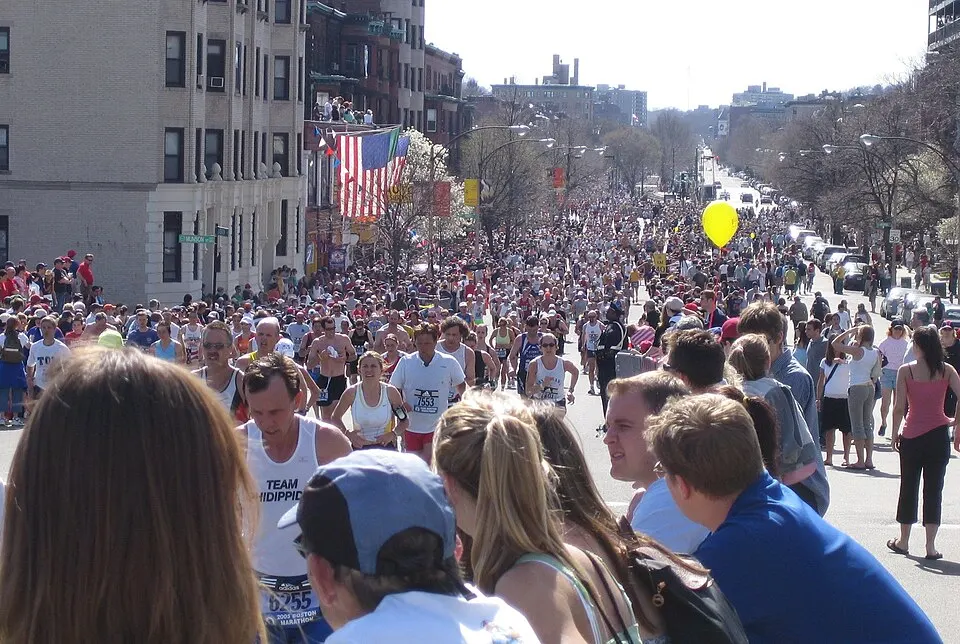
1Boston — no intermediate cut-offs, followed by 4 climbs after 26km
Boston has no section-by-section cut-off point table. Only one finish closes, at 5:30 p.m.
That is the time set to reopen the roads through the eight cities and towns on the course route; runners arriving afterward receive a finish finisher medal, but the final results list them as 'Post-Race Participant.' Clocks throughout the course show the same 5:30 p.m.
cutoff. Wave 1 starts at 10:00, and Wave 6 at 11:21, leaving the final wave 6 hours 9 minutes. With no cut-off point closing in stages along the route, the document needed to read course comes down to the elevation profile.
From Hopkinton to Boylston Street, total ascent is 246.88m and total descent 375.95m. Together, that makes a net descent of 129m. But the descent comes early.
At 26km, the mark enters Newton, where four climbs arrive in succession, the last of them Heartbreak Hill. From 32.67km to 33.33km, the course rises 27.5m over 660m, for an average gradient of 4.20%. A net descent is easy to read as a fast course.
Boston’s elevation profile records the order of events. The legs cash in the early downhill miles on four climbs after 26km.
 Boston MarathonMon, April 19, 2027 · D-204 · Boston, United StatesSee race details
Osaka, Japan
2Osaka Marathon — evenly spaced cut-offs, with the first 5km the key hurdle
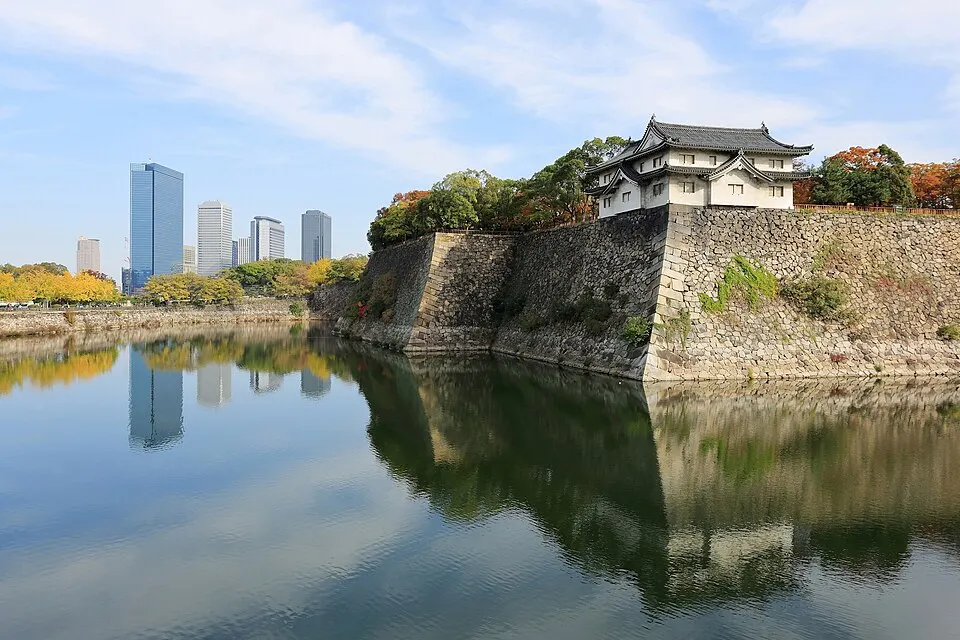
Divide the ten cut-off point points in the 2026 Osaka Marathon by distance and time, and the pattern is nearly a straight line. The race starts at 9:15, with the 5.0km cut-off point at 10:44. From there to 11.8km, the required pace is 8 minutes 49 seconds per kilometer; to 16.5km, 8 minutes 56 seconds; to 22.6km, 8 minutes 41 seconds; and to 25.6km, 9 minutes.
Through 30.5km and 34.2km, then to 37.4km, it stays between 8 minutes 45 seconds and 8 minutes 55 seconds. The first real easing comes after 39.4km: 9 minutes 30 seconds to the 41.4km cut-off point, then 8 minutes for the remaining 795m to the finish inside Osaka Castle Park. When the cut-off point intervals are this even, the reading is clear: there is no course section for which the organizers have added extra time.
In this city course, starting outside Osaka Prefectural Government and finishing inside Osaka Castle Park, the required pace is almost unchanged from start to finish. That leaves one warning in the cut-off point table: the opening stretch. The first 5km allows 89 minutes, while covering 5km at the pace required in the later sections takes about 44 minutes.
The 45-minute difference is the entire buffer available for congestion before the start line, and not once before 41km does a section restore that time.
 Osaka Marathon 2027Sun, February 28, 2027 · D-154 · Osaka, JapanSee race details
Kobe, Japan
3Kobe — 10m of elevation change, with tight cut-offs through 23.9km
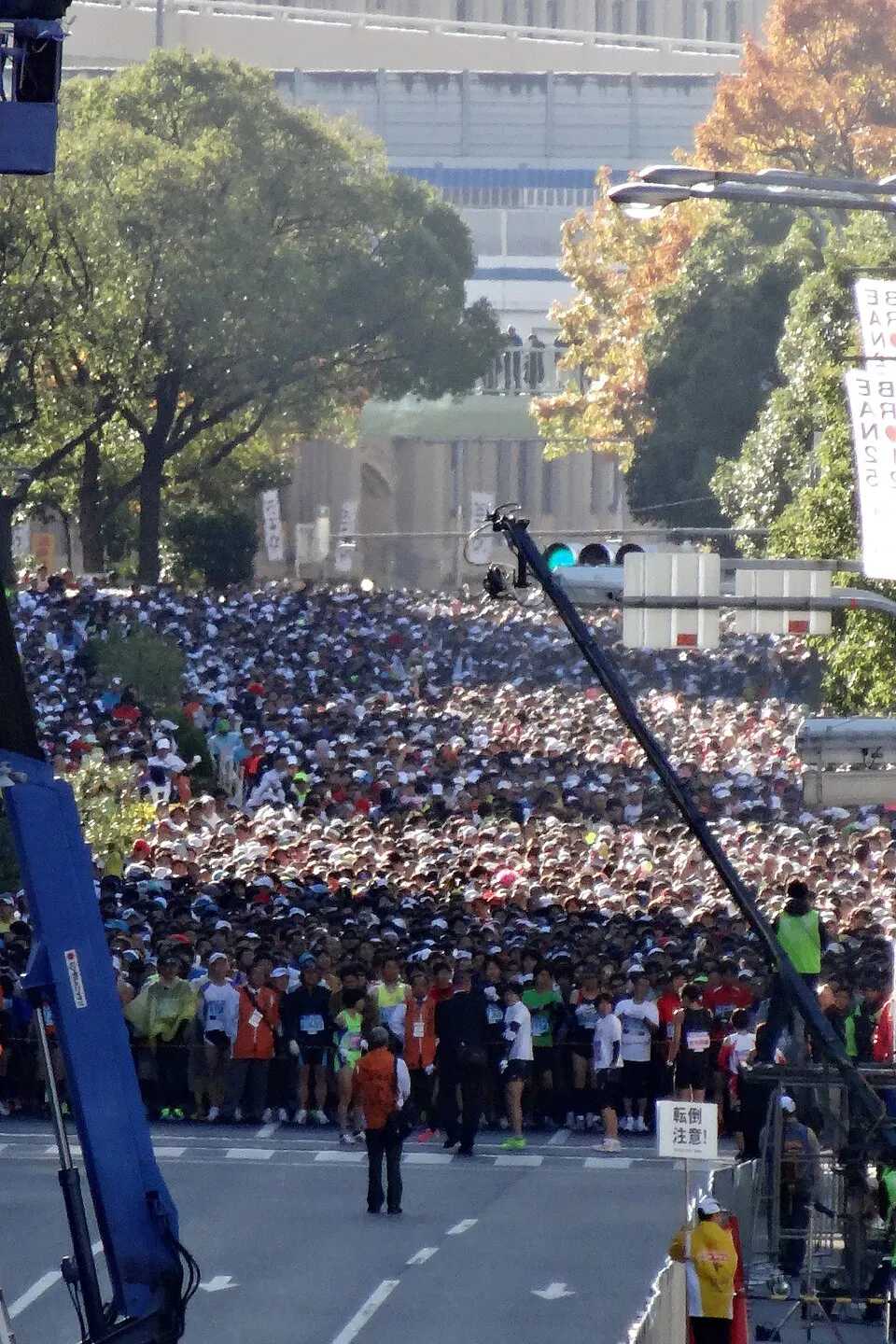
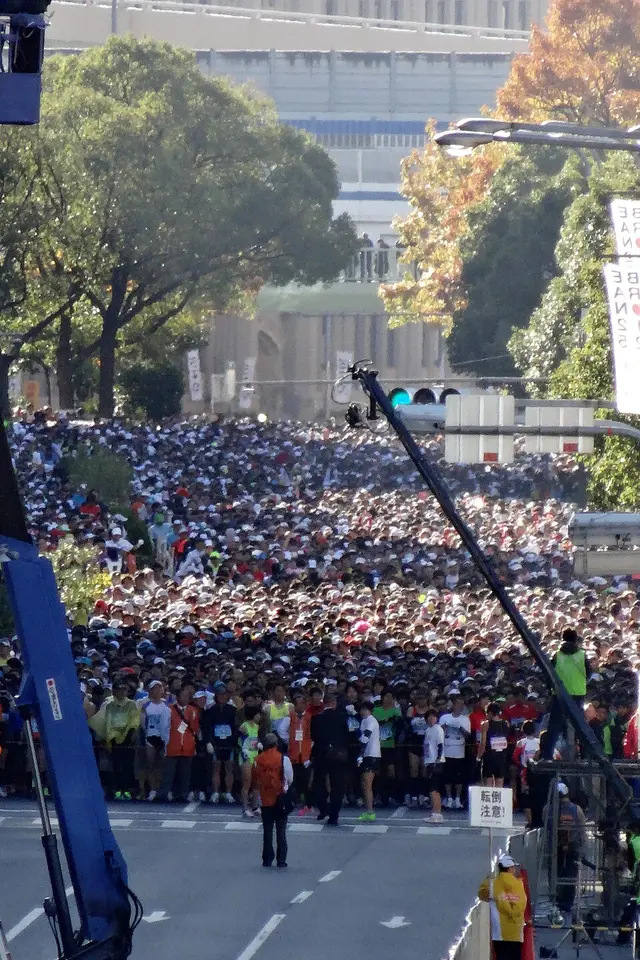
Kobe Marathon's official elevation profile is scaled to 50m on the vertical axis, yet the line stays glued to the bottom. The organizers put the total elevation change at about 10m. Only two narrow peaks catch the eye, just after 9km and around 32km.
The course heads west from Kobe City Hall through Suma and Tarumi, turns at Okura Coast, where the Akashi Kaikyo Bridge comes into view, and finishes at Kobe Harborland. The two peaks sit almost symmetrically on either side of turnaround point. The ground is flat, but the cut-off point table is not.
Reading the 11 scheduled cut-off point together, the required pace from 3.8km to 23.9km ranges from 8 minutes 31 seconds to 8 minutes 45 seconds per kilometer. The allowance loosens to 9 minutes 22 seconds through 27.1km, 9 minutes 45 seconds through 31.1km, 10 minutes through 32.7km, 10 minutes 22 seconds through 35.4km, and 10 minutes 40 seconds through 39.8km. For the final 2.395km, 11 minutes 16 seconds per kilometer is allowed.
This slope, unexplained by the terrain, shows that the organizers have added time for late-race fatigue. As a result, the point at which runners in Kobe reach cut-off point comes earlier. The first cut-off point, at 3.8km, closes at 10 a.
m., 60 minutes after the first starting signal. The time limit 7-hour limit is measured from the first signal at 9 a.
m.; the second wave starts at 9:15 a.m.
For runners at the back of the second wave who were late reaching start line, the key point in this course comes well before turnaround point, where the bridge first appears—during the first hour, before reaching the Suma coast.
 KOBE MARATHON 2026Sun, November 15, 2026 · D-49 · Kobe, JapanSee race details
Kanazawa, Japan
4Kanazawa Marathon — a long early climb and the first cut-off at 5.4km
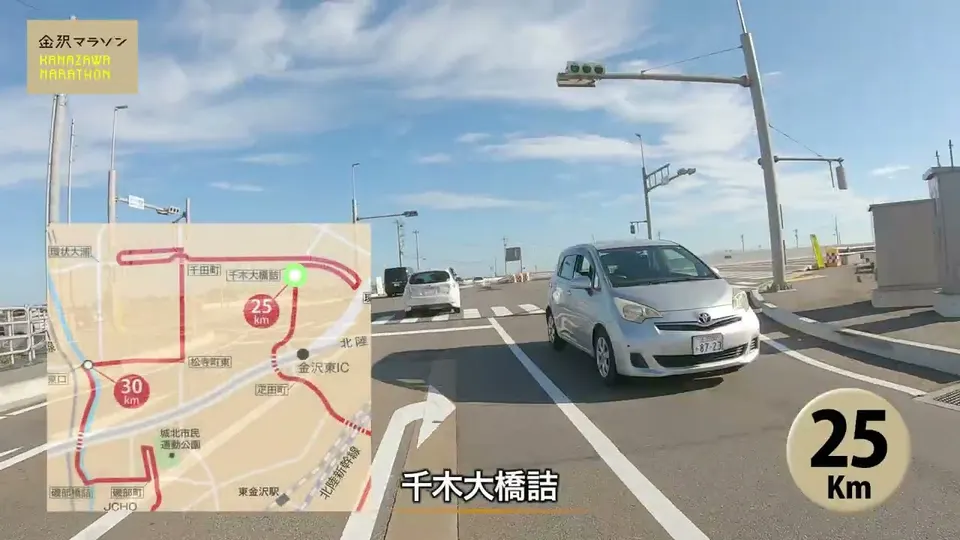
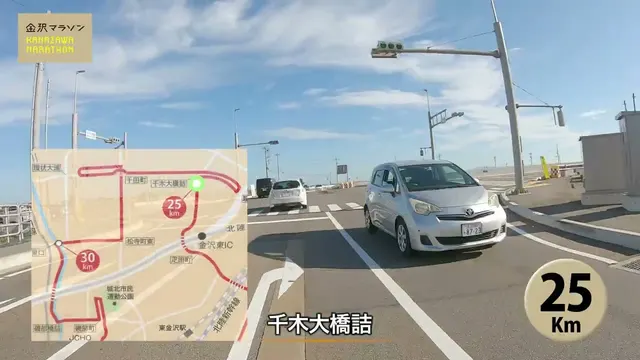
Kanazawa Marathon's course guide gives no elevation figures. The clue is hidden in the aid-station descriptions. The organizers describe the station around 11.2km as a place to encourage runners who have completed the long opening climb.
Course follows a loop through seven zones, from the historic scenery of Kenrokuen, Ishikawa-mon Gate at Kanazawa Castle and Higashiyama to the rural zone, with distant views of the Hakusan range. The course also includes a mountain-side arterial road usually reached only by car and a viaduct crossing the river terrace. It starts at 8:30 a.
m. in front of the Shiinoki Cultural Complex and finishes at the Ishikawa Prefecture Seibu Ryokuchi Park Athletics Stadium. It is a World Athletics- and AIMS-certified course.
Overlay the nine cut-off point, and one section stands out. Between the 8.6km cut-off point (10:13 a.m.)
, which covers the end of the climb at 11.2km, and the 15.9km cut-off point (11:20 a.m.), runners get 67 minutes for 7.3km, or 9 minutes 11 seconds per kilometer.
In the preceding 5.4km to 8.6km, the allowance is 9 minutes 4 seconds; the following sections range from 9 minutes 11 seconds to 9 minutes 27 seconds. The course does not grant extra time for the stretch containing the long climb. The only conspicuous easing comes after the 38.8km cut-off point, when 37 minutes are allowed for the final 3.395km.
The time limit 7-hour limit is based on the first wave's gun time, and results are recorded as gross time from each wave's gun. Starting outside the assigned wave may result in disqualification. For later waves, that means entering the climb with any time already lost at start line still on the clock.
That makes the calculation for this course finish before the 11.2km aid station. How many minutes ahead of the first cut-off point at 5.4km (9:44 a.m.)
determines how much the pace can ease on the climb.
 Kanazawa Marathon 2026Sun, October 25, 2026 · D-28 · Kanazawa, JapanSee race details
Fukuoka, Japan
5Fukuoka Marathon — the tightest cut-off comes after the Kyushu University climb
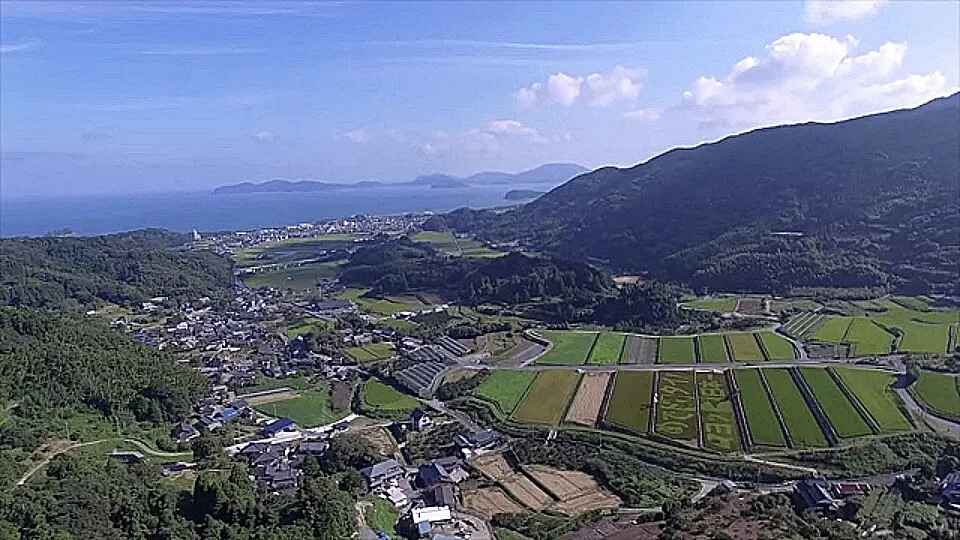
Fukuoka Marathon is a point-to-point course that starts at 8:20 a.m. on Tenjin Watanabe-dori and finishes near the Shima-kan building at the Itoshima City Exchange Plaza.
The organizers describe it as suitable for beginners because it has few major rises and falls, while singling out two demanding points: the gradual climb toward the Kyushu University Ito Campus entrance around 20km, and the 25m elevation change leading to Futamigaura around 35km. Dividing the nine cut-off point by distance and time gives a required pace ranging from 9 minutes 25 seconds to 9 minutes 47 seconds per kilometer. The spread is narrow.
The order matters. The tightest section is the 9 minutes 25 seconds from 19.8km to 25.0km, after passing the campus cut-off point. Next comes the 9 minutes 27 seconds from 14.3km, climbing toward the 19.8km cut-off point in front of the campus.
Third is the 9 minutes 30 seconds from 32.9km to 36.9km, which includes Futamigaura. The loosest section runs from 25.0km at Imazu Sports Park to 29.8km at Kitazaki Elementary School, at 9 minutes 47 seconds per kilometer. Every race advises banking time before a climb.
Fukuoka's cut-off point table puts that advice into numbers. After climbing, runners go straight into the day's tightest section with tired legs, making the slope at the Kyushu University campus entrance a test set by two cut-off point at once: 19.8km and 25.0km.
 Fukuoka Marathon 2026Sun, November 8, 2026 · D-42 · Fukuoka, JapanSee race details
Toyama, Japan
6Toyama Marathon — in severe weather, an uncertified course replaces the route over Shinminato Bridge

Toyama Marathon starts at 9 a.m. in front of Takaoka City Hall, passes through Imizu, and finishes at Kansui Park beside the Fugan Canal in Toyama.
Midway through the course, runners pass Shinminato Fishing Port and the sailing ship Kaiwomaru before climbing onto Shinminato Bridge, with one condition attached: if the organizers determine that the bridge cannot be used because of severe weather, the course is operated as an unofficial sub-course. Even on the same day, finishing the same race does not guarantee an official course result; the morning weather decides. All 10 cut-off point are published by location, but only the first and last include distances.
The point near 9.2km at Takaoka Driving School is timed for 10:41 a.m.; the point near 41.6km at the Kibamachi intersection is timed for 3:59 p.
m. From the start to the first cut-off point, 101 minutes are allowed. From there to the final cut-off point, 318 minutes are allowed for 32.4km, or 9 minutes 49 seconds per kilometer.
The eight locations in between become legible only when plotted on a map. The third cut-off point, in front of the Shinminato Fisheries Cooperative Association, is timed for 12:09 p.m.
; the fourth cut-off point, in front of Horioka Elementary School after the bridge, is timed for 12:51 p.m. The two cut-off point, with the port and bridge between them, are 42 minutes apart.
The course changed slightly in 2026. The Akasofu turnaround point is about 260m shorter, the Imizu old course turnaround point about 180m shorter, and the finish section about 440m longer. Timing is recorded at the start, every 5km, the halfway point and finish.
The entry requirements state that runners must be capable of finishing within 6 hours 45 minutes, making the 15-minute gap from the 7-hour limit the margin built into this race. The cut-off point table, with no distances, is easy to skim past. In Toyama, it should be read the other way around.
The first number to check is not time limit but the 42 minutes from the port, across the bridge and on to Horioka.
 Toyama Marathon 2026Sun, November 1, 2026 · D-35 · Toyama, JapanSee race details
Editor's pick
Runners worried about missing cut-off point should not start by comparing elevation change. First identify where they tend to slow. Those who are late through start line should choose Osaka.
The first cut-off point at 5.0km allows 89 minutes; using the roughly 8 minutes 50 seconds per kilometer required in the later sections leaves about 45 minutes to spend before the start. In Kobe, the same calculation leaves less than 30 minutes to the 3.8km cut-off point. For runners who fade late, Kobe is the better fit.
Through 23.9km, the pace must stay inside 8 minutes 45 seconds per kilometer, but after that the cut-off point keeps opening to 10 minutes 40 seconds. Kobe is the only one of the six course to do that. Fukuoka and Kanazawa offer no extra time on the climbs, making them harsher for runners who rely on a strong finish.
Boston has no cut-off point and judges the race against a single 5:30 p.m. cutoff, but the final wave has 6 hours 9 minutes.
If the 10m elevation figure led to choosing Kobe as the first course, training should test pacing through the opening 3.8km in under 60 minutes, not just late-race endurance. Reading a course ultimately means finding that one sentence.
The elevation profile appears on the race’s course page, while the cut-off point schedule is listed separately in the race regulations or participant guide. Overlaying the two requires only a calculator.
The resulting kilometer-by-kilometer paces are the numbers to write on a watch for race day.
Entry period · Accommodation
| Races | Itinerary | Entry period | INFO. |
|---|---|---|---|
| Boston Marathon | Mon, April 19, 2027 | Mon, September 14, 2026 ~ Fri, September 18, 2026 | Accommodation · See race details |
| Osaka Marathon 2027 | Sun, February 28, 2027 | Tue, July 28, 2026 ~ Fri, August 28, 2026 | Accommodation · See race details |
| KOBE MARATHON 2026 | Sun, November 15, 2026 | Fri, April 17, 2026 ~ Mon, June 1, 2026 | Accommodation · See race details |
| Kanazawa Marathon 2026 | Sun, October 25, 2026 | Fri, April 10, 2026 ~ Wed, May 20, 2026 | Accommodation · See race details |
| Fukuoka Marathon 2026 | Sun, November 8, 2026 | Mon, April 20, 2026 ~ Wed, May 20, 2026 | Accommodation · See race details |
| Toyama Marathon 2026 | Sun, November 1, 2026 | Sat, April 11, 2026 ~ Tue, June 30, 2026 | Accommodation · See race details |
Auto-translate on · Official race site
More stories
 Hokkaido's autumn marathons: seven races, and where you can really run a full 42 km
 Japan marathons: if Osaka and Tokyo are both ballots, where do you run a first marathon?
 Tokyo Marathon course: why runners slow down in the second halfOsaka Marathon 2027: what to wear when the normal high is 12.1°C and last time it hit 21.4°C