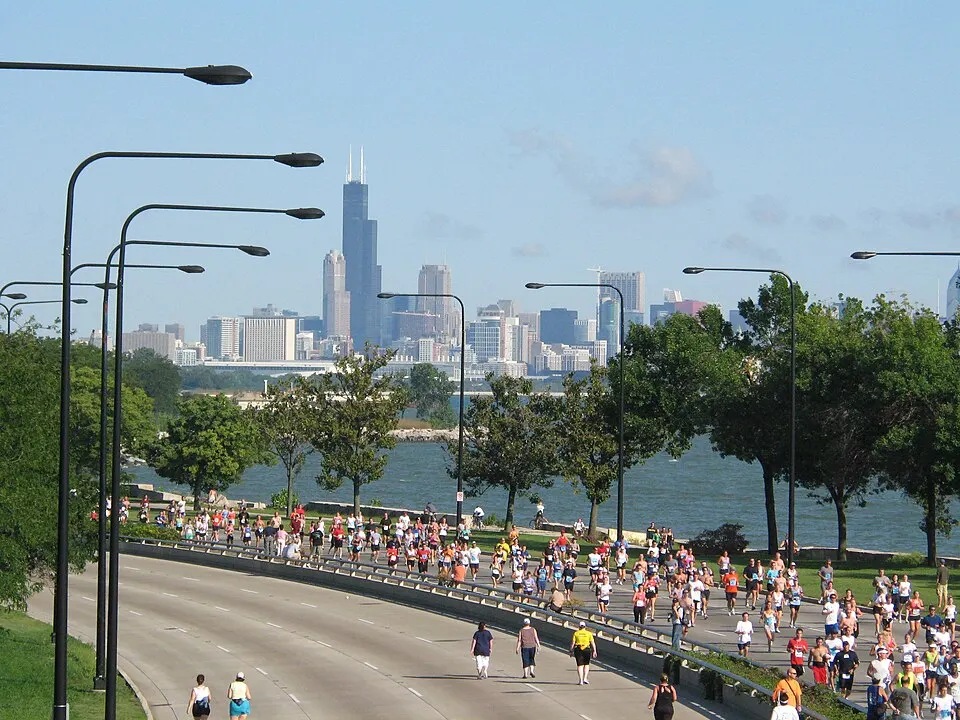
Chicago, United States · Senne
What to Wear at the Chicago Marathon Depends on Your Wave, and How to Plan Throwaway Layers
On October 11, Grant Park opens at 5:30 a.m. for gear check, and the final wave starts at 8:35. Race-day clothing depends not on a single forecast reading but on the three hours between those times.
When the gates at Grant Park open at 5:30 a.m.
, it is still dark in Chicago. Sunrise is at 6:57.
Runners assigned to bib walk across the grass, queue up and enter corral—then wait again. On October 11, Chicago's typical low is 8.4°C and its high is 18.3°C.
The temperature the body remembers at start line and the temperature encountered at 30km mark can differ by nearly 10°C. Clothing has to account for that span, and anything discarded along the way is gone for good.
1Wave Start Times and a Wait of Up to 3 Hours
Entry to Grant Park begins at 5:30 a.m. Gear check opens at the same time.
Sunrise in Chicago is at 6:57, so the earliest arrivals spend 87 minutes inside the park before daylight. Runners leave the same start line in eight separate starts. Wheelchair Division goes at 7:20 a.
m. (men) and 7:21 a.m.
(women), followed by the handcycle start at 7:23, the professional athletes at 7:30, and the high-performance program at 7:32. Wave 1 starts at 7:35, Wave 2 at 8:00 and Wave 3 at 8:35. Corral closes separately for each wave: 7:20 for Wave 1, 7:45 for Wave 2 and 8:10 for Wave 3.
From closure to the starting gun, Waves 1 and 2 have 15 minutes; Wave 3 has 25. During those 25 minutes, the body barely moves on a road packed with runners in front and behind. Put the numbers together and the picture is clear.
A Wave 3 runner who enters the park at 5:30 a.m. waits 3 hours 5 minutes for the start.
For someone finishing in 4 hours, the wait equals three-quarters of the running time. In Chicago, the first variable in choosing clothing is not the forecast but the wave number printed on bib.
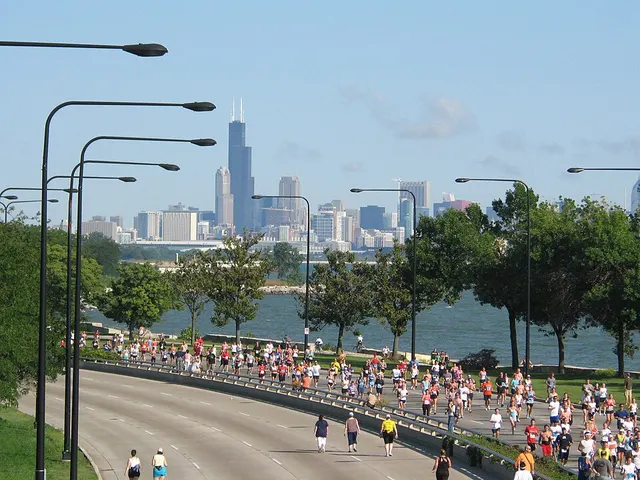 Bank of America Chicago MarathonSun, October 11, 2026 · D-13 · Chicago, United StatesSee race details
2Race-Day Temperatures of 8.4–18.3°C, and Why Runners Wear Throwaway Layers
According to 1991–2020 climate normals for Chicago O'Hare, the typical low on October 11 is 8.4°C and the high is 18.3°C—a 9.9°C swing over the course of the day. Averaged across October, the figure becomes 12.4°C, a temperature that does not occur at any single point on race day. The 8.4°C arrives before dawn; the 18.3°C arrives in the afternoon.
Clothing is chosen around the 8.4°C end of that range. Runners leave their lodging in the dark, enter the park, sit and wait, then stand in corral. For those three hours, the body needs insulation.
Ten minutes after the gun, that need reverses. Whether a runner passes finish in the 2-hour range or the 6-hour range, the final 10km falls on the part of the temperature curve rising toward the day's high. That is where the attempt to manage the race in a single outfit fails.
Dress for 8.4°C and the extra layers will feel ready to come off around 15km; dress for 18.3°C and the wait at corral becomes three hours in the cold. There is only one workable solution: put on the clothes intended for the run first, then add layers that can be discarded.
3Leave Throwaway Clothing in the Collection Area; Gear Check Closes at 4 p.m.
The organizers’ guidance is brief: check the forecast and don’t bring more extra clothing than necessary. The next line states that clothing discarded at start line cannot be recovered. There are designated drop-off points.
Clothing-collection areas marked with signs sit near the start at corral and inside corral. Discarded clothing belongs there. Throwing it onto the road has a different outcome: clothing placed in the collection areas is gathered and sent elsewhere, while clothing left on the course gets trampled by the wave behind.
For items that need to be collected later, there is gear check. Only the official clear plastic bag is accepted, and valuables should not be left inside. The race also states that it is not responsible for lost, stolen, or damaged property.
One more deadline matters. Gear-check bags must be collected by 4 p.m.
on race day. Any bags not claimed by then are moved to the Grand Tradition Room at the Hilton Chicago, where they remain available from 5:30 p.m.
to 7 p.m. Set beside the warning that it can take more than 30 minutes to reach the meeting point from finish, the gear-check decision carries an extra hour after the finish.
4The 4-Level Event Alert System and Colored Flags at Aid Stations
Chicago uses a color-coded system to signal the day’s conditions. Called the Event Alert System, it has four levels. Green means low.
Conditions are good, but runners are still told to enjoy the race with caution. Yellow means moderate: conditions are not ideal, and runners are advised to slow down and prepare for deterioration. Red means high and indicates potentially dangerous conditions.
Slow down, monitor course, follow race-official instructions and consider stopping. Black means extreme: race cancellation, extreme and dangerous conditions, and no participation. The levels are determined mainly by weather and announced before the race.
On race day, they appear in public-address announcements and on color-coded signs and flags. Those markers are not limited to the start and finish areas. The same color is displayed at all 20 aid station locations along course.
Every 1~2 miles, runners see the day’s color again. That system matters to clothing for a simple reason. A race that starts under a green alert can shift to yellow by midday, and the place where runners notice that change is aid station.
When the alert rises by one level, the adjustment is not to clothing but to pace. The clothing is already set; at 30 km, mark, the only thing that can be changed is the watch.
531.1°C Heat in 2007 Forced the Course to Close After Four Hours
A black alert is not hypothetical. In the 2007 Chicago Marathon, course closed four hours after the start. At noon that day, temperatures in Chicago reached a record 31.1 degrees, with high humidity.
Of the 45,000 registered runners, about 10,000 did not show up at start line, and 10,934 of those who started failed to finish. One participant died on course. The alert system, the placement of aid station, misting stations and cooling buses are features of the race that followed that day.
The colored flags seen at course also came from it. The second Sunday in October was chosen to avoid the heat, but it does not eliminate it. Heat and humidity recur in finishers’ race reports.
Across several years, runners have written about missing their target pace at 6 miles and seeing others stop with cramps or exhaustion. Those same reports consistently praise the spectators. The race is lined continuously by people along course, leaving memories of shouting together at the 25-mile marker alongside the day’s finishing time.
6A Flat Course, 20 Aid Stations, and No Hydration Packs
Starting and finishing in Grant Park, course passes through 29 neighborhoods. The organizers describe course as the site of 7 world records. Almost no elevation change helps the watch and hurts on a hot day, because the climbs do not force runners to slow down.
Course remains open for 6 hours 30 minutes, a pace of 15 minutes per mile pace. The vehicle following the final starters at pace signals when the roads will reopen. Runners who arrive after 4 p.
m. may not be recorded as official finishers. There are 20 aid station locations, spaced 1~2 miles apart.
Each aid station is arranged in this order: medical tent, portable toilets, Gatorade Endurance Lemon-Lime, public-address announcements and water. Medical support is available at course 22 locations, the total of aid station 20 locations plus two more between 14~15 miles and in the final 1 mile. There are separate rules for fluids carried on the course.
Hydration packs are prohibited regardless of design. Fuel belts and handheld bottles are permitted, but runners may be asked to empty them before entering Grant Park. In practice, carrying personal fluids as far as course is effectively blocked, leaving runners to rely on all 20 locations for hydration planning on a hot day.
7Allow 30 Minutes for the Family Reunion Area After the Finish—and Pack Dry Clothes
Finish is also inside Grant Park. Family meeting points are marked by red towers labeled A through Z at Butler Field, and the race warns that reaching them from finish can take more than 30 minutes. The 27th Mile postrace party opens at 9:30 a.
m. and closes at 4 p.m.
In Chicago in October, those 30 minutes belong in the calculation. Air that felt like 18.3°C while running reaches a body standing still in sweat-soaked clothing differently. That is where the presence or absence of a dry change of clothes after finish matters.
Editor's pick
For Waves 1 and 2, a single thin layer is enough to discard. Corral closes 15 minutes before the start, so the wait on the starting line is brief. Wave 3 requires a different calculation.
There is no reason to enter the park at 5:30 a.m., and because corral closes at 8:10, delaying entry works in the runner's favor.
Even so, if the wait will exceed an hour, prepare two outer layers to discard. Put the top one in the collection area and shed the lower one around 8km. For a time goal, dress for 18.3°C and use discarded clothing to manage the cold.
For a first Chicago, the recommendation is the reverse. On a day when the warning level reaches yellow or higher, forcing a time on the flat course can prove costly. The goal should shift from a finishing time to simply finishing.
The starting wave and corral symbol appear on bib. Check those two lines first, calculate how many hours separate 5:30 a.
m. from the assigned start, then pack the bag.
Entry period · Accommodation
| Races | Itinerary | Entry period | INFO. |
|---|---|---|---|
| Bank of America Chicago Marathon | Sun, October 11, 2026 | Tue, October 21, 2025 ~ Tue, November 18, 2025 | Accommodation · See race details |
Auto-translate on · Official race site
More stories
 December marathons in Southeast Asia: Singapore costs the most of seven, Chiang Mai has no ballot
 World Marathon Majors by Course: Tokyo and Chicago for Time, Sydney for the View
 TCS New York City Marathon Registration: Five Ways In Besides the Lottery
 Marathon registration beyond the Majors: how eight Platinum Label races let you in