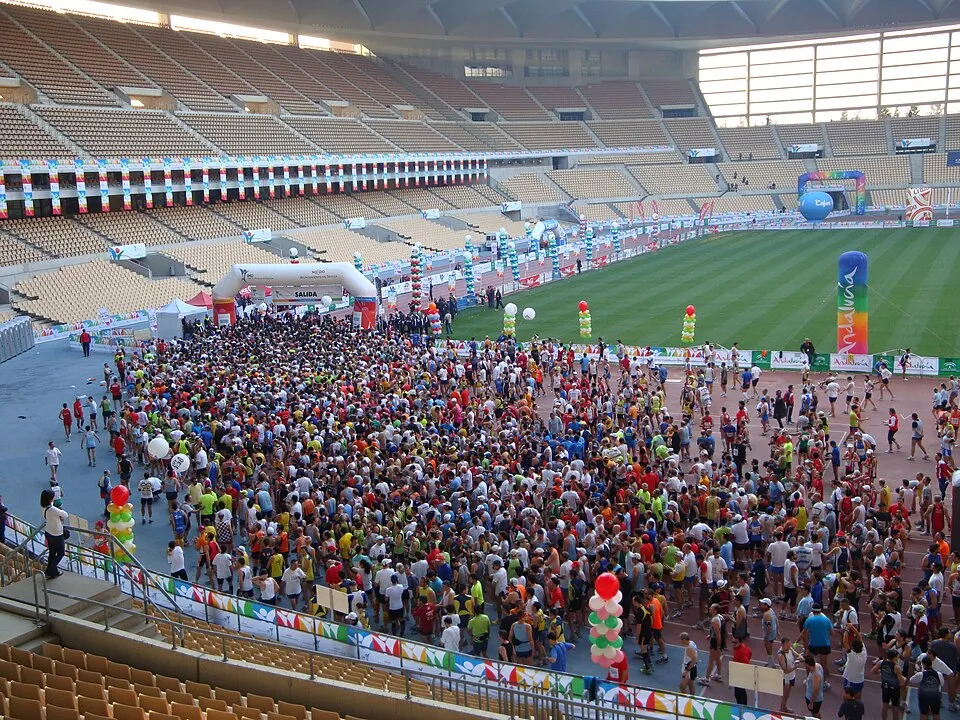
Seville, Spain · Blot
Chasing a PR Abroad? Seville, Where Eight National Records Fell in 2024
It is known as Europe's flattest marathon, course. The entire course sits at sea level, and the wind is generally sheltered. But the real reason this course is fast is not elevation; it is the layout. Aid stations and pacer and timing points are arranged around running fast.
It is known as Europe's flattest marathon, course. That is not hyperbole.
The entire course stays at sea level, with virtually no elevation change, and it carries the World Athletics label course. It is now ranked as the sixth-fastest marathon in the world.
The results support the claim. The course record is 2 hours 3 minutes 27 seconds, set by Deresa Geleta in 2024.
That same year, 12 runners finished inside 2 hours 8 minutes, 24 women finished inside 2 hours 28 minutes, and eight national records fell. With 250 elite athletes and 14,000 recreational runners, it is Spain's third-largest race.
But the real reason this course is fast is not elevation alone. Aid stations, pacer and course markers are all positioned around performance, while late-February temperatures in Andalusia complete the design.
1A flat course at sea level; field capped at 20,000 runners
Start line is located on Avenida de María Luisa. Course stays flat and at sea level throughout. Organizers describe this course as one of Europe's flattest marathons, course, with a layout that is generally sheltered from the wind.
The 2027 race filled its 20,000 places in 11 days. That was a record, 3,000 more than the previous edition, and only the waitlist is now open. No elevation change means more than no climbs.
It also means no descents. There is no downhill on which to bank time before paying it back uphill; the result comes down to whether the same pace can be held from the start to the finish.
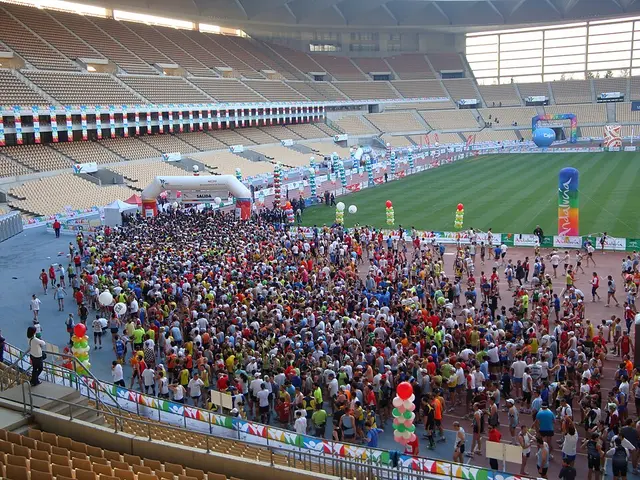 Zurich Seville MarathonSun, February 21, 2027 · D-98 · Seville, SpainSee race details
2Watch the pace through Plaza de España early in the race
Course passes Seville’s most recognizable landmarks in succession. First come Plaza de España and the adjoining Parque de María Luisa. Built for the 1929 Ibero-American Exposition, the site still has its semicircular arcade and the canal that curves in front of it.
Visitors usually combine the two in a half-day course. The race passes them within its first few kilometers. Sightseers and runners move through the same place at entirely different speeds.
On a flat course, the early landmarks cut both ways. They make the pace come easily, and this course offers no downhill to repay the effort. A glance at the watch is worthwhile while passing Plaza de España.
3Torre del Oro, La Giralda, and the bullring
Along the Guadalquivir, the course passes the Torre del Oro. Built in the 1220s under the Almohads, the 12-sided military watchtower controlled river traffic. The riverside stretch opens up the view.
Then comes the Giralda, the bell tower of Seville Cathedral. It began as an Almohad minaret. A 16th-century Renaissance belfry was added above the Islamic-era tower, bringing its height to about 104m.
One spire thus layers the architecture of two religions. That is Seville’s defining silhouette. The La Maestranza bullring also stands along course.
Construction began in the mid-18th century, and the arena took more than a century to complete. The three landmarks sit within a few minutes of one another on foot, making this a stretch to remember rather than simply photograph. On the flat course, the moment a runner stops to take out a camera becomes the record.
4Water stations every 2.5 km; gels available from 20 km
Half the reason this course is fast lies in its aid-station design. Water and sports drink are available at 5·10·15km mark. At 20·25·30·35·40km mark and finish, runners also get gels, energy bars, fruit and nuts, in addition to water and sports drink.
Separate water-only intermediate aid station are positioned at 7.5·12.5·17.5·22.5·27.5·32.5·37.5km mark. Water comes every 2.5km rather than every 5km. The gels used at course are supplied by 226ers, and pacer are operated by target time.
Every kilometer is marked both on vertical signs and on the road surface. ASICS is the technical sponsor.
56-hour cut-off; finish closes at 3 p.m.; February temperatures of 7–18°C
The 2027 race starts at 8:30 a.m. on February 21, and Wheelchair Division goes off one minute earlier, at 8:29 a.
m. At 8:30, before the tourists are out, course passes Plaza de España and the Giralda at their quietest. Time limit is 6 hours, measured from the start of the final runner, and finish closes at 15:00.
A sweep vehicle follows the back of course, and runners who cannot maintain the prescribed time limit pace must board the vehicle or withdraw. February in Seville is mild. The average daytime high is around 18°C, the low around 7°C, and monthly precipitation is about 46mm.
The same course does not produce the same time in an Andalusian summer. Seville is not a fast course; February in Seville is a fast course.
6€82.10 entry fee; bib pickup and getting to the start
The Seville Marathon has been held every year since 1985. The marathon at the 1999 World Athletics Championships took place in the city, and the race has carried a World Athletics Gold Label since 2018. The women’s course record is Alemu Megertu’s 2 hours 18 minutes 51 seconds, set in 2022.
Entry fee costs 82.10 euros for nonresidents, plus 5 euros for a Spanish Athletics Federation license. Registration was scheduled to run from April 9, 2026, through February 15, 2027, but the 20,000-place field is already full and only a waiting list remains. Puerta de Jerez, Prado de San Sebastián and San Bernardo stations on Metro Line 1, Tussam city buses, and San Bernardo station on Cercanías lines C1, C4 and C5 are close to start line.
Bib and the runner bag can be collected at the Runners’ Expo in the FIBES Exhibition and Convention Centre from two days before the race. Hours are 10:00 to 20:00 on Friday, February 19, and Saturday, February 20. A confirmation document and identification (passport) are required.
Collection by a representative requires the confirmation document, a copy of the runner’s identification, and a signed authorization letter. Nothing will be distributed on race day.
7Seville Half Marathon on November 29; 3-hour cut-off
Seville also has a separate half marathon. The 32nd edition takes place in the same city on November 29 and is a different race from full marathon. Both the start and finish are on Paseo de las Delicias, and the entire course is asphalt.
The start is at 9:00 a.m.; time limit is 3 hours, and finish closes at 12:10 p.
m. Runners who cannot maintain an average pace of 8 minutes 30 seconds per kilometer may be asked to leave course. Aid stations are located at 5·10·15·18.5km mark and finish, with sports drink also available at 10km mark.
Solid food is distributed at finish. Bib can be collected only at the Runners’ Expo from 10:00 a.m.
to 8:00 p.m. on November 27 and 28, the two days before the race.
A collection date and time must be selected in advance on the registration platform. Race-day collection is not possible. Participants must be at least 18 years old on race day; there are no restrictions based on gender or nationality.
If bib for the February full marathon was unavailable, this remains an option. It is a different half marathon, however, with a time limit of 3 hours, so the two races serve entirely different purposes.
Editor's pick
For a race aimed at taking time off a personal best, the advantage here is not elevation but consistency. No climbs and no descents mean there is no excuse to alter pace, while water every 2.5km keeps the rhythm from breaking for a drink. Target-time pacer point in the same direction.
But this course does not cover mistakes. On a flat course, an aggressive opening cannot be repaid with a downhill later. If the first 10km is faster than the target pace, the race has already gone wrong.
When combining the race with sightseeing, reverse the order. Plaza de España, the Giralda and the Torre del Oro all sit along course, so returning after the finish leaves a stronger memory than walking the route the day before.
The claim of being Europe's flattest course is a description of the course design, not a marketing line. Sea-level elevation, a layout protected from the wind, water every 2.5km, two types of markers at every kilometer, and pacer for each target.
Beyond that come Plaza de España, the Torre del Oro and the Giralda. It is rarer than expected to find an course chasing a time and an course taking in the city on the same course.
Entry period · Accommodation
| Races | Itinerary | Entry period | INFO. |
|---|---|---|---|
| Zurich Seville Marathon | Sun, February 21, 2027 | Thu, April 9, 2026 ~ Mon, February 15, 2027 | Accommodation · See race details |
Auto-translate on · Official race site
More stories
 December Marathons in Southeast Asia: Singapore Costs the Most, Chiang Mai Has No Lottery
 The 6 Majors and Sydney: Some Courses Are Built for PRs, Others for the View
 New York City Marathon: Five More Ways In Besides the Lottery
 Platinum Label Isn't Just for the Majors: Valencia, Seoul, Lisbon, and More