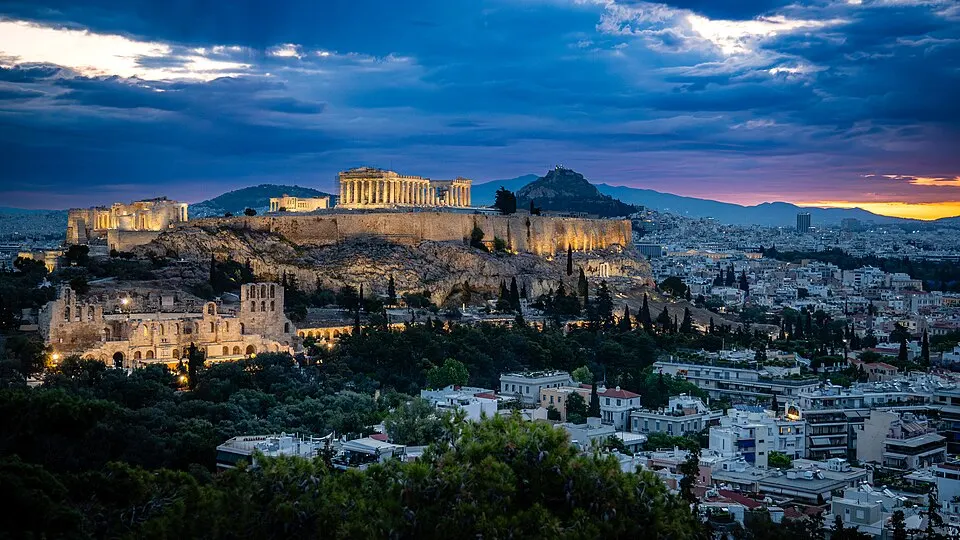
Athens, Greece · Senne
The Athens Marathon Climbs for 21 km, From 10 km to 31 km
The marathon takes its name from this road. The stretch said to have been run by Pheidippides after the victory at the Battle of Marathon in 490 BC becomes course itself. But romance only goes so far: from 10km to 31km, 21km of the course runs uphill.
Marathon is a place-name. The city of Marathon lies 42km northeast of Athens, on the plain where Persian and Athenian forces met in 490 BC.
The event takes its name from the story of a soldier who ran the victory message to Athens, and this race uses that route as course. That history is usually the first thing people mention when describing the race.
For runners, the more immediate fact is this: from 10km mark to 31km mark, the course climbs continuously for 21km. Elevation rises from a low of about 7m to a high of about 249m.
No course among the world's major marathons has an uphill section this long. The entire course is paved, apart from the final 170m on the tartan track inside the Panathenaic Stadium, the marble venue of the first modern Olympic Games in 1896.
It would not be wrong to describe the race as 42km of endurance for the sake of those final 170m.
1The race starts in Marathon, 42km from Athens
Most marathons start in the middle of a city. This one starts in the city of Marathon, 42km from Athens. This isn't a race that borrowed a famous name; this is the place whose name became the name of the event itself.
Soon after the start, course passes the burial mound of the Athenian soldiers killed in the Battle of Marathon in 490 BC. The route then follows the coast near Nea Makri. The first third is flat.
The race began in 1972. In 2015, 43,000 people took part, including 16,000 who ran full marathon. The distance of 42.195km did not originate here, but the origins of running that distance lie on this road.
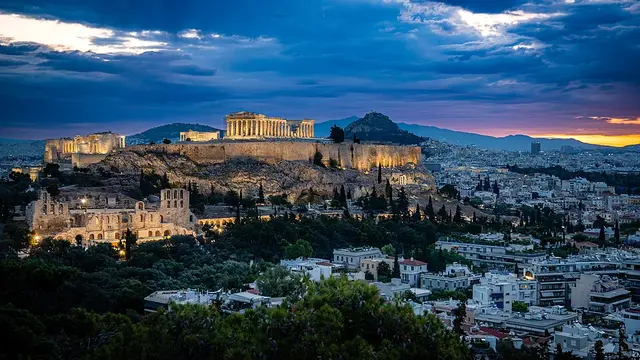 Athens Marathon. The AuthenticSun, November 8, 2026 · D-20 · Athens, GreeceSee race details
2From 10km to 31km: 21km Uphill
This is why the race cannot be explained through romance alone. From 10km mark to 31km mark, course climbs continuously. No major marathon in the world has an uphill section this long.
The challenge is not the steepness but the length. This is not a single hill that rises and ends; it is a gradual climb lasting more than 20km. Whether the legs have anything left from the opening flat section becomes apparent in full.
It is better to remember that course divides clearly into three sections. The first third is flat, the middle third is uphill, and the final third is downhill. Because the hills are concentrated in the middle of the race, an ambitious opening can leave pace in pieces before 30km.
The numbers tell the story. Elevation rises from about 7m to about 249m. Gaining 242m over 42km does not make this a mountain course, but the problem is that the climbing is concentrated between 10km and 31km.
An average gradient of just over 1 percent continues without a real break for 21km.
3Downhill after 31km, with the finish at Panathenaic Stadium
After 31km mark, course turns into a gradual descent. The legs have to absorb the downhill after climbing for 21km, and this is where the finishing time is decided. Once the route reaches the city, it passes the statue of a running man.
Known in Greek as O Dromeas, the glass sculpture has become a symbol of runners in Athens. Then the route enters the Panathenaic Stadium. It was the finish of the first modern Olympic Games in 1896 and the finish of the marathon at the 2004 Athens Olympics.
The race ends inside the marble stadium. The final 170m are run on tartan. After 42km on asphalt, the legs suddenly meet a different surface, with the marble stands closing in on both sides.
This is the scene most often mentioned by finishers of the race.
48-hour cut-off; registration closes September 25
The start is at 9 a.m., and the time limit is 8 hours.
That is nearly two hours longer than at most races. Alongside full marathon, the program includes a 10K and a 5K, as well as a separate 5K night run for university students. If full marathon feels too demanding, there is another option on the same weekend: a race through central Athens.
The 2026 race takes place on November 8. Registration opens on April 24, 2026, and closes on September 25. The window opens six months before race day and remains available for nearly six months, so registration is not cut-off point for this race.
That figure reflects not generosity but the nature of course. Put more than 20km of climbing into a marathon and set a six-hour limit, and few runners would finish. It is more accurate to read the time limit as a race designed with walking sections in mind.
5Free shuttles to the start run from 5 a.m.
The fact that start line lies outside the city means covering 42km before the race even begins. Organizers run free shuttles from six pickup points beside metro stations to the marathon town. The first wave runs between 5:00 and 6:45, although the last bus from Syngrou-Fix leaves at 6:15.
The second wave runs between 6:30 and 7:45. Drivers are dropped off about 800m from start line, and organizers advise against driving. In other words, race-day wake-up time is not calculated backward from the start.
It is calculated backward from the shuttle schedule. Waking at 8:00 for a 9:00 start means missing start line.
6Bib Unavailable on Sundays
The rule most often missed at this race concerns Packet Pickup. The runners’ center is at the Faliro Indoor Gym and Exhibition Center, the former Olympic Taekwondo venue in the Olympic Faliro coastal district. Opening hours are 12:00 to 21:00 on Wednesday, November 4, 2026; 10:00 to 21:00 on Thursday, November 5, and Friday, November 6; and 10:00 to 20:00 on Saturday, November 7.
On race day, Sunday, runners cannot collect bib or their race kits. That makes 20:00 on Saturday the practical deadline. Arriving on a Saturday afternoon flight means any delay could prevent a start at start line.
An itinerary that gets into Athens by Friday is the safer plan. The official expo runs at the same venue during the same period, from November 4 through 7. Rather than treating it as a stop to make while collecting bib, it is better to think of bib as something that must be collected during those four expo days.
7Race-day temperatures of 16–22°C; short sleeves and a throwaway layer
Packing for winter because the race is in November can backfire. Late October and November in Athens and southern Greece are generally mild. The race-day forecast calls for a high of 22°C and a low of 16°C, with temperatures around 17°C at the start rising to about 21°C.
Average humidity is around 69 percent. The chance of rain is low. The complication is that the temperature rises as the course climbs.
The stretch from 10km to 31km coincides with the fastest warming of the day. If the starting area feels cold and too many layers go on, there is nowhere to shed them at 15km mark. A short-sleeved top with one light layer over it is the sensible setup, with anything disposable at start line.
Water stations are placed along course, but on the climbs, protecting pace matters more than forcing down a particular amount.
Editor's pick
This is not a race for chasing a personal best. The climb from 10km to 31km is not a section for calculating pace; it is a section to endure. Finish time depends on how much is left in the legs for the descent that follows.
Building a plan around an extra 20 to 30 minutes over a typical finish time is the realistic approach. What the race offers instead cannot be found anywhere else. It starts at the place where the name originated and finishes at the finish of the first modern Olympic Games in 1896.
Even without a recorded time, the fact of running between those two points remains. The most important part of preparation is not training but the morning plan. The first shuttle starts running at 5 a.
m., and driving is not recommended. Booking accommodation near a shuttle stop is the most practical preparation for this race.
The word marathon comes from this place name, and the act of running that distance began on this road. But the weight of being the original and the difficulty of the course are two separate things.
The first third is flat, the middle third is twenty-one kilometres of climbing, and the final third runs downhill. Remember those three sections and hold back early, and you can make it to the marble steps of the Panathenaic Stadium.
Entry period · Accommodation
| Races | Itinerary | Entry period | INFO. |
|---|---|---|---|
| Athens Marathon. The Authentic | Sun, November 8, 2026 | Fri, April 24, 2026 ~ Sat, April 25, 2026 | Accommodation · See race details |
Auto-translate on · Official race site
More stories
 December marathons in Southeast Asia: Singapore costs the most, Chiang Mai has no ballot
 World Marathon Majors by Course: Tokyo and Chicago for Time, Sydney for the View
 New York City Marathon: Five More Ways In Besides the Lottery
 Platinum Label Isn't Just for the Majors: Valencia, Seoul, Lisbon, and More